





Eye For Film >> Movies >> Sunday Ninth (2025) Film Review



When we read the information that a certain film is competing as a first feature, we usually assume that the film comes from a young filmmaker whose self-assurance could exceed the level of command of the craft. However, with Sunday Ninth, which premiered at Black Nights Film Festival in Tallinn, it is the opposite case. Kat Steppe is not a young, up-and-coming filmmaker, and, formally, Sunday Ninth is not her first feature-length film, since she debuted with a documentary Bedankt & Merci 15 years ago. The topic Steppe chose to deal with in her first attempt at fiction feature is also not something that appeals to younger generations, as it deals with sickness and death, meaning that it demands to be approached with at least some level of maturity and wisdom.
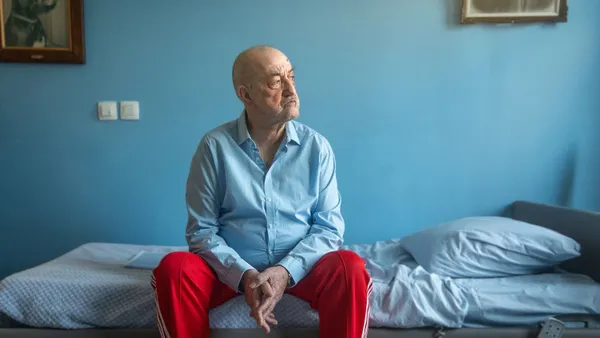
The two estranged brothers, Horst (Josse De Pauw, quite a presence here) and Franz (Peter Van den Begin, of King Of The Belgians fame) have always had a complicated relationship marked with rivalry and grudges. However, with Horst placed in the care facility for the people suffering dementia, and Franz in desperate need of money, the ethical questions of assisted suicide and inheritance arise. While the doctor (Frank Lammers) tries to ensure the brothers live in some kind of balanced and safe environment, which is getting harder because of Horst’s violent outbursts, the appearance of Andrea (Kristien De Proost) with whom both brothers share a certain past, opens a new level of traumas and makes the deeply buried secrets come to life.

The plot alternates between the idle staleness of the present and loosely structured potentially traumatic events of the past, told in flashbacks, which makes it feel quite convoluted at places. But Sunday Ninth is not a film about plot and mysteries that have to be resolved – though it might come as a bonus at some point – but of vibe and emotion. There is plenty of that in both the central timeline and the flashbacks, as the brothers turn out to be in some kind of conflict with each other since their young adulthood, and that they were differently traumatised by the actions of their parents.
In that domain, Steppe points us towards the actors who do fantastic work individually and in the interplay with one another. De Pauw is great as Horst, a frail, but still-threatening presence bursting with volatile, even violent energy, while Van den Begin has a different task to portray the still collected and lucid, but sometimes cynical, scheming and petty person prone to holding onto grudges. As Andrea, De Proost brings a bit of mystery to the mix, so the viewers are prepared for the diffuse flashbacks marked with different sets of actors and the enigmatic Edwige Baily and Yoann Blanc as the parents.
However, the talk of the film will be its ethics and the use of the actual Alzheimer’s patients as extras and as part of the background. That can be tricky on multiple grounds: would the patients feel exploited and their space invaded for the filmmaking purposes? How could the actors react to the potentially unpredictable reactions of the patients? Would it be more ethical to select professional actors for those small roles, or could that be seen as insulting? Finally, even the title comes from a syntagm repeatedly said by one of the real patients, and, since all that she has been saying, one could assume that she is far from lucid and able to consent. Was she maybe “scouted” and cast for her “trait”?
From what we can see on the screen, it is obvious that the interaction between the actors and the patients was natural, but respectful and that no ethical or humane boundaries were crossed. Also, that presented the chance for a thorough assessment of De Pauw’s acting skills when he is paired with the non-actors. In the end, everything comes up to a very remarkable and deliberately envisioned debut by the filmmaker who possesses good skills, some wisdom and a good sense of measure. Sunday Ninth is a bit messy, but the situations it portrays are such as well.
Reviewed on: 21 Nov 2025


